

Electronic Door Lock
An electronic door lock is a locking device that grants access using an electronic credential, such as a transponder, SmartCard or smartphone, instead of a mechanical key. It sits at the heart of any digital locking system, and this glossary entry explains how it works, the benefits it offers over a conventional mechanical lock, how it is installed, and where it can be used.
Contents:
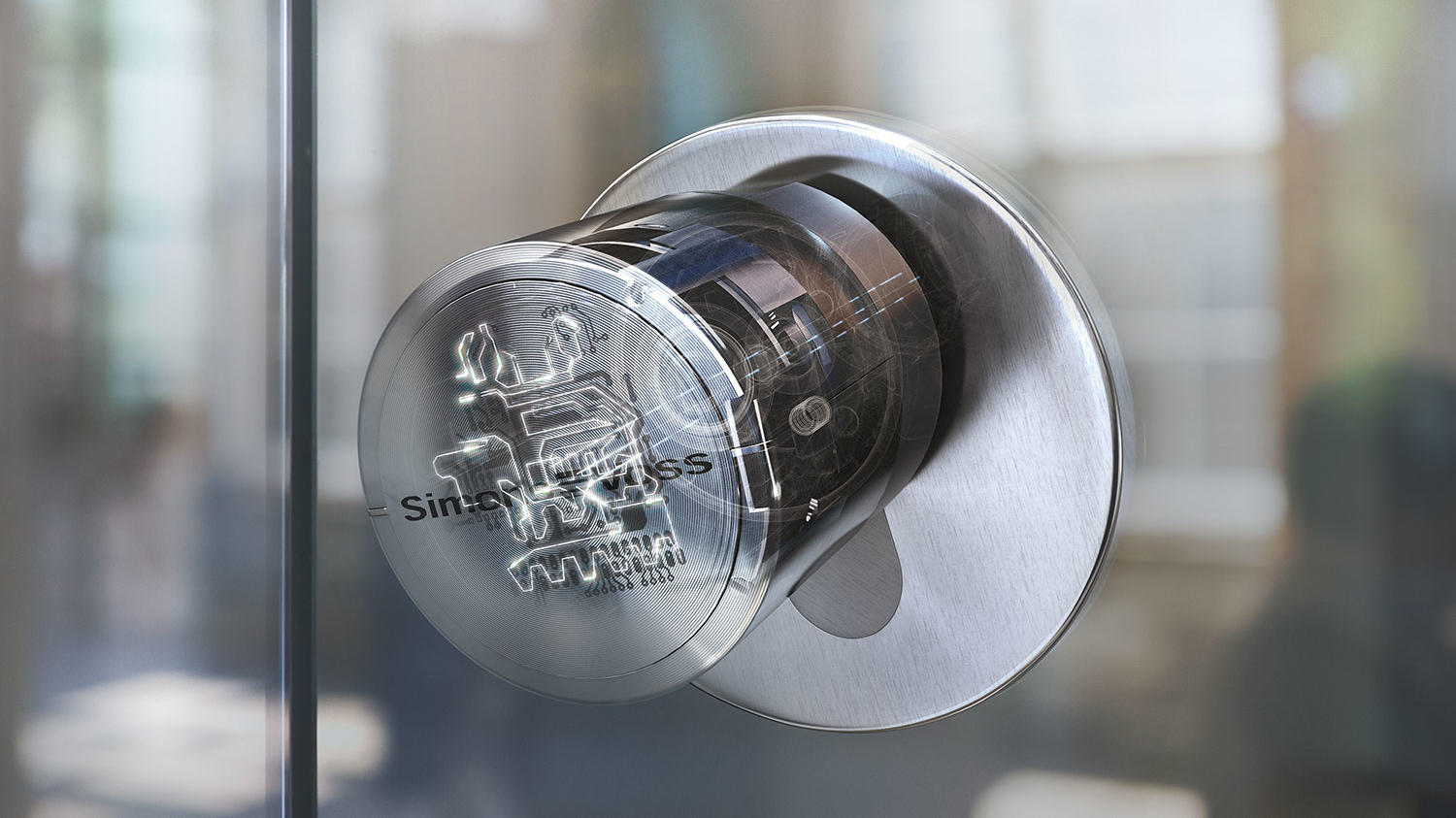
▶ Definition and benefits of an electronic door lock
Digitalisation is transforming almost every aspect of building management, including the way doors are secured. As an alternative to conventional mechanical locks, doors can be equipped with electronic door locks.
Instead of a mechanical key, the door is opened using an electronic credential such as a transponder or SmartCard. This offers considerably more functionality than simply locking and unlocking a door, and it can prevent significant inconvenience and expense if a credential is lost.
An electronic locking system offers a number of benefits, set out below.
❯ No major security issue if a credential is lost
In short: a lost electronic credential can be blocked in minutes, whereas a lost mechanical key can mean rekeying or replacing every affected lock.
Anyone who has ever lost a key will be familiar with the uncertainty it creates. Not only is the key missing, but there is also a risk that somebody else could use it to gain access. If keys, cylinders or other locking components need to be replaced, the costs can quickly mount up.
With an electronic door lock, a lost credential can simply be blocked. Security can therefore be restored quickly, with the immediate replacement cost generally limited to the credential itself.
❯ Fast replacement
A lost credential can be replaced quickly. A new transponder, for example, can be programmed in the locking-system management software, such as SimonsVoss LSM software, and made ready for use without having to replace the lock.
❯ All access permissions on one credential instead of multiple keys
The more locks that need to be operated, the larger the key ring becomes, at least with conventional mechanical locking systems.
With a digital locking system, a single electronic credential can be authorised for numerous electronic door locks and other access points. Users therefore only need to carry the credential appropriate to their role.
❯ Fast and straightforward management of access permissions
Electronic systems make it easy not only to replace credentials but also to change access permissions. If another person needs to be added to the system, a new credential can be programmed and issued quickly.
Existing permissions can likewise be amended when responsibilities, working patterns or access requirements change, using a system such as AX Manager.
❯ Straightforward installation, even during normal operations
Electronic door-lock systems can generally be installed without major disruption to normal operations. Depending on the door and product configuration, installation may not require additional drilling or extensive alterations to the door.
This can be particularly valuable for businesses and facilities where access points need to remain operational and disruption must be kept to a minimum.
❯ Low operating costs and straightforward expansion
Maintenance can generally be carried out while the system remains operational. The system can also be expanded if, for example, additional rooms, floors or buildings need to be incorporated later.
This scalability makes electronic locking particularly attractive for organisations whose premises or access requirements change over time.
❯ DoorMonitoring for comprehensive monitoring and event logging
Electronic door locks can do more than control access. With DoorMonitoring, door status information can be recorded and unusual events reported promptly.
Depending on the configuration, the system can identify whether a door is open, closed or locked, and can detect events such as a door being left open for an unusually long time or an unauthorised access attempt.
❯ Time-controlled access permissions
Access permissions can also be restricted to particular times. For example, if cleaning staff should only have access outside normal office hours, their credential can be configured to work only during a specified time window, such as between 8pm and 6am.
❯ Smartphone access, depending on the product
Many electronic locking solutions, including SimonsVoss MobileKey, also support access via smartphone. This allows the smartphone to function as a mobile credential, depending on the system and product used.
Electronic locking systems therefore offer considerable flexibility. The principal consideration is the initial investment required. However, operating costs can be comparatively low, and organisations do not necessarily need to convert every access point at once. A phased rollout makes it possible to begin with the most important or security-critical access points and expand the system gradually as requirements evolve. Our guide to how digital locks work covers the underlying mechanics in more detail.
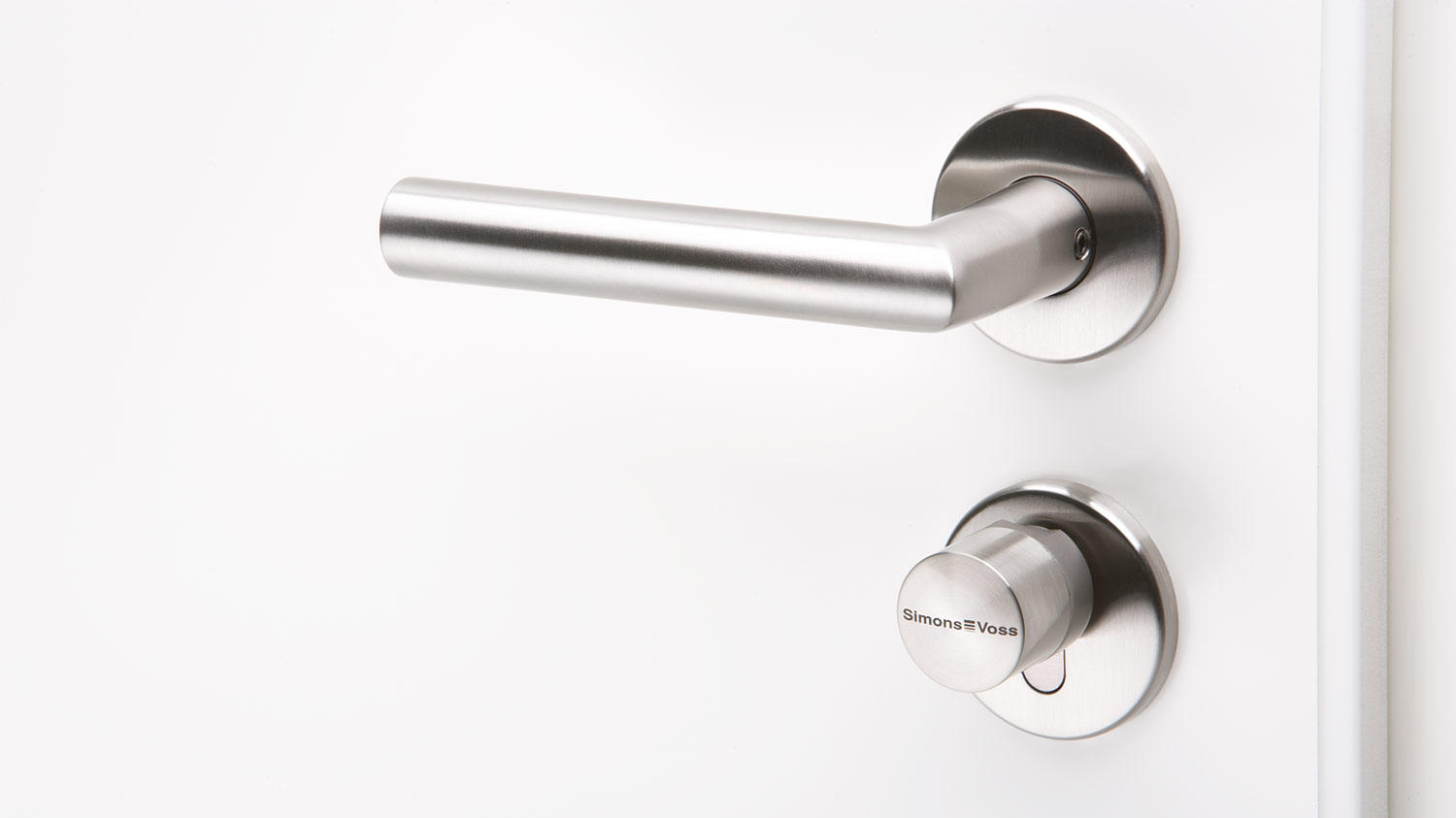
▶ Installation and maintenance
In short: installation is generally straightforward and can be carried out during normal operations, but it should always be done by appropriately trained personnel.
Once an organisation has decided to introduce electronic door locks, two practical questions arise: how complex is the installation, and who should carry it out? Although installing electronic locking components can be relatively straightforward, installation should be undertaken by appropriately trained personnel.
Using a SimonsVoss double-knob cylinder as an example, installation typically involves the following steps:
1. Remove the non-electronic knob.
2. Insert the cylinder through the door in the correct orientation.
3. Fit the supplied cylinder retaining screw and tighten it by hand. Do not use a power screwdriver.
4. Refit and secure the non-electronic knob.
5. Check that the cylinder and lock operate correctly and move freely.
Self-explanatory installation videos for the latest AX generation are also available on the SimonsVoss service pages.
If you are unsure who can install an electronic locking system at your premises, a qualified SimonsVoss specialist partner can provide support.
One of the key advantages is that installation can generally be carried out during normal operations. In a commercial or industrial environment, this means that work or production does not necessarily need to stop while electronic door locks are installed.
The system can also be expanded at a later date. If the initial installation does not cover the entire property, further access points can be added as requirements change.
Regular maintenance is important too. Preventive inspection can identify potential issues before they result in faults or disruption and can help keep long-term operating costs under control.
Electronic locks require a power source, but battery-powered products are designed for long operating periods. Depending on the product and operating conditions, battery life can extend to several years, with some SimonsVoss configurations offering up to 12 years in standby mode.
Battery flat?
A flat battery in a cylinder or transponder may sound inconvenient, but electronic locking systems are designed to provide advance warning.
The procedure depends on the cylinder model. On some cylinders, the battery compartment can be accessed in a way that allows the batteries to be replaced from the outside.
With battery life of up to 12 years in standby mode on certain products, replacement is relatively infrequent. A two-stage visual and acoustic warning system also provides advance notice when battery power is running low, and replacing the batteries in a cylinder or transponder can be completed very quickly.
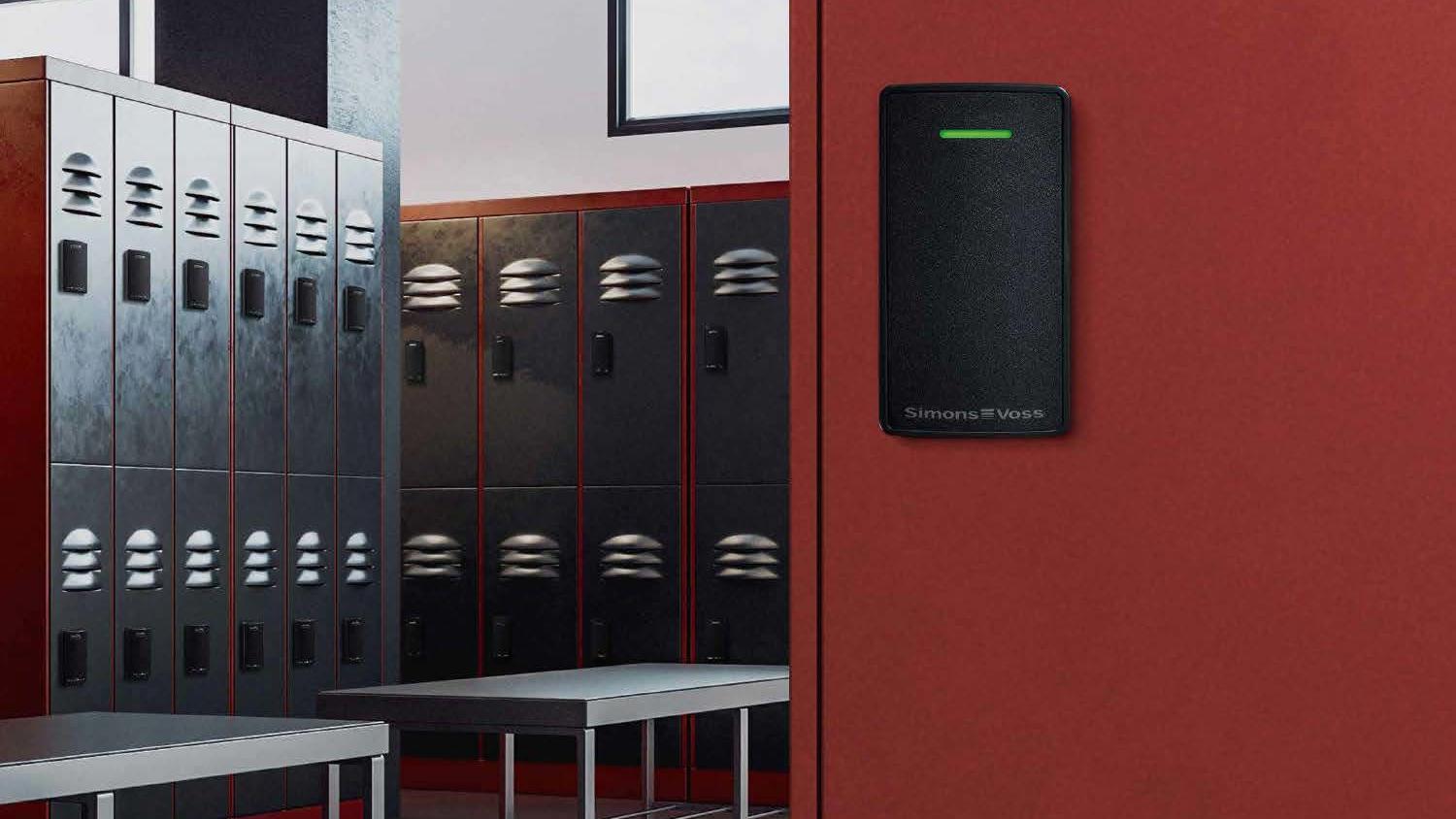
▶ Applications for electronic door locks
In short: electronic locks can replace a mechanical key almost anywhere, from main entrances and internal restricted rooms to weather-resistant outdoor applications such as gates and car parks.
In principle, digital locking technology can be used in many places where a mechanical key would traditionally be required. This includes both indoor and outdoor applications, as well as other access points such as gates and garages.
The most obvious example is the main entrance to a building, whether a residential property, office, commercial facility or industrial site. An electronic door lock ensures that access is granted only to authorised users, and if a credential is lost, it can be blocked quickly.
The same principle applies throughout a digital locking system. Once inside the building, electronic locks can be used on a wide range of doors, including offices, server rooms, production areas and other restricted spaces.
One of the key benefits is that not every user needs to have the same access permissions. Cleaning staff, for example, can be given access only to the areas they need to enter, and their permissions can also be time-controlled so that access is available only outside normal business hours.
Electronic locks can also be used outdoors, provided that the product is specifically designed for external conditions. Weather-resistant versions, such as digital padlocks, are available for applications such as gates, outbuildings, car-park entrances and garage access.
For outdoor applications, the relevant product specification and ingress protection should always be considered when selecting the appropriate locking solution.
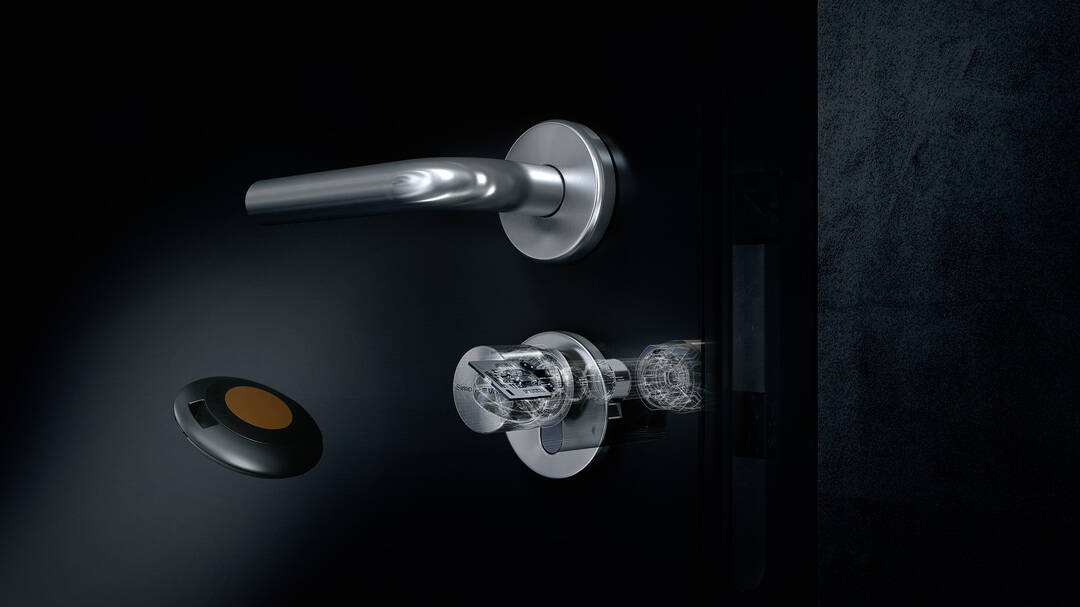
▶ How an electronic door lock is opened
With a mechanical lock, the process is familiar: insert the key, turn it and open the door. An electronic door lock can be even simpler to operate, but the technology behind it provides considerably more functionality than simply opening and closing a door.
The key advantage is that one electronic credential can be authorised for multiple doors and other access points. Each credential can be programmed individually, meaning that a transponder, SmartCard or other credential can carry precisely the access permissions required by its user.
Electronic locking solutions use technologies including RFID and NFC, while many electronic door locks also support Bluetooth communication. Our guide to the six core technologies behind access control explains how these compare.
The main methods of opening an electronic door lock are set out below.
❯ Transponder
In short: a transponder is an active credential the user presses against a reader to open a compatible lock.
The word transponder is formed from transmitter and responder. SimonsVoss transponders use active technology: to operate a compatible lock, the user actively presses the button on the transponder.
A transponder will usually form part of a particular locking system. Some models can also incorporate an additional chip that enables the credential to be used with other compatible systems. The robust housing helps protect the transponder against accidental damage and deliberate misuse.
If a transponder is lost, its access permissions can be revoked within the locking system. A replacement can then be issued without having to replace the electronic locks themselves.
❯ SmartCard
In short: a SmartCard is a passive credential presented to a reader, working on the same principle as a hotel key card.
Using a card to open a door is a familiar form of electronic access control. Hotel key cards are perhaps the best-known example: present the card to the reader, the credential is verified and the door can be opened.
The same principle can be used for long-term access in offices and other facilities. SmartCards use passive technology, and depending on the card and system, technologies and formats such as MIFARE® Classic, MIFARE Plus® and MIFARE® DESFire® can be supported.
This can be particularly useful where an organisation already uses card-based technologies. A staff ID card used for functions such as time recording or cashless payments may, subject to system compatibility, also be incorporated into the access control system.
The SmartTag belongs to the same broad category of passive credentials. It provides similar functionality to a SmartCard in a compact tag format.
❯ Smartphone
In short: a smartphone app can act as a mobile credential, which is especially useful for temporary or one-off access.
For many users, the smartphone is something they carry with them throughout the day, making it a convenient potential access credential.
Solutions such as MobileKey allow compatible electronic locks to be managed digitally and, depending on the configuration, operated using a smartphone. Mobile solutions can be particularly suitable for smaller businesses, residential applications and mixed-use premises.
Temporary access permissions can also be useful where access is required only once or for a limited period. For example, a service engineer or contractor can be granted temporary access without having to be issued with a conventional mechanical key.
❯ Access code / PIN / keypad
In short: a PIN keypad suits locations with high or frequently changing user numbers, since codes can be issued and changed without a physical credential.
A PIN keypad can be combined with an electronic door lock to provide convenient access in locations with high or frequently changing user numbers.
A conference venue is one example. Guests can be given a four- to eight-digit code that enables access for the duration of an event. For multi-day events, codes can be changed as required, and a new PIN can be created for each subsequent event.
This allows access to be managed without issuing a physical credential to every temporary user.
❯ Fingerprint
In short: a fingerprint reader authenticates the user's biometric data directly, and its use in the UK is subject to GDPR and Data Protection Act requirements.
Fingerprint-based access may once have seemed futuristic, but biometric access control is now established technology. A fingerprint reader positioned near the access point captures biometric information and uses it to authenticate the user before access is granted.
Because biometric access control involves the processing of biometric data, organisations using it in the UK need to consider the applicable requirements of the UK GDPR and Data Protection Act 2018, including the additional protections applying to biometric data used to uniquely identify an individual.

▶ Security: are electronic door locks safer than conventional mechanical locks?
In short: electronic locks remove the single biggest weakness of a mechanical key, the inability to control who holds a copy, and add monitoring capability on top.
Electronic door locks can provide significant security advantages over conventional mechanical locking systems.
One of these is credential management. A properly secured electronic credential is substantially different from a conventional mechanical key: rather than relying solely on the physical possession of a cut key, the system verifies an electronically managed credential.
The consequences of losing a credential can also be much easier to manage. If a mechanical key is lost, there is a risk that whoever finds or steals it may be able to use it to gain access. Depending on the locking system and security requirements, affected cylinders may then need to be rekeyed or replaced.
A lost electronic credential, by contrast, can be blocked within the locking system. A replacement credential can then be issued without replacing every affected electronic lock.
Digital systems can also provide additional monitoring capabilities. DoorMonitoring, for example, can detect door states such as open, closed and locked, as well as a door being left open for an unusually long period.
Access events and access attempts can also be logged, allowing authorised administrators to investigate events retrospectively. The system can additionally report critical events such as unauthorised access attempts.
Where access-event records relate to identifiable individuals, their processing and retention must comply with applicable UK data-protection requirements.
Integration with fire and life-safety systems requires particular care. Electronic access control must not compromise the safe operation of escape routes or fire doors. Any central release or emergency-unlocking functionality must form part of the building's appropriate fire strategy and be compatible with the relevant doors, exit devices and other life-safety systems, such as panic exit locks.
▶ Why investing in an electronic door lock makes sense
OFrom smaller properties to large organisations, digital locking systems can be used across a broad range of applications.
The initial investment may appear higher than for a conventional mechanical solution. However, a digital access control system is a long-term investment, and ongoing costs can be reduced through more efficient credential management, straightforward system expansion and the ability to carry out maintenance without extensive disruption.
Additional doors, rooms, floors or buildings can be incorporated as requirements evolve, helping organisations avoid the operational complexity associated with replacing or restructuring conventional mechanical key systems.
Digital locking can therefore provide a scalable approach for organisations looking to improve security while simplifying access management. Explore the full range of SimonsVoss digital locking systems, or read how digital key management compares with a traditional master-key system.
FAQ
What happens if an electronic door lock credential is lost?
The lost credential can simply be blocked within the locking system, and a replacement can be issued without replacing the lock itself. This is different from a lost mechanical key, which can require affected cylinders to be rekeyed or replaced.
How long do electronic door lock batteries last?
Battery life depends on the product and how it is used, but some SimonsVoss configurations offer up to 12 years in standby mode. A two-stage visual and acoustic warning system gives advance notice before the battery needs replacing.
Can an electronic door lock be opened with a smartphone?
Yes, many electronic locking solutions support smartphone access, using the phone as a mobile credential. This is particularly useful for granting temporary access, for example to a contractor or service engineer, without issuing a physical credential.
Are fingerprint door locks legal to use in the UK?
Fingerprint access is legal in the UK, but because it involves processing biometric data, organisations must comply with the UK GDPR and the Data Protection Act 2018, including the additional protections that apply to biometric data used to uniquely identify an individual.
Can electronic door locks be used outdoors?
Yes, provided the product is specifically designed for external conditions. Weather-resistant versions are available for gates, outbuildings, car parks and garages, and the ingress protection rating should be checked against the intended application.
Would you like to learn more from the SimonsVoss specialists?
Do you still have questions about electronic door locks or digital locking technology? Get in touch and we will help you find the right solution for your requirements.