

Panic Exit Lock
A panic exit lock, also called an anti-panic lock, is a locking device that always allows a door to be opened from the escape side without a key, while remaining secured against unauthorised access from the outside. In an emergency, the seconds it takes to find a key can be the difference between a safe evacuation and a dangerous bottleneck, which is why this class of lock is specified on fire escape routes across commercial and public buildings.
Contents:

▶ Panic exit locks: definition and construction
A panic exit lock, also known as an anti-panic lock, has a particular role within a locking system. The fundamental requirement is that the associated door can always be opened from the escape side without a key, while remaining secured against unauthorised access from the outside.
This is particularly important in the event of a fire or other emergency. Occupants should not have to search for a key before they can leave the building, since escape routes need to provide a clear and readily usable route to safety.
At the same time, the security of the building must be maintained. From the secure side, the door can therefore remain locked, with access granted using a key or another authorised credential.
Panic exit locks can be used on both single- and double-leaf doors. One of their key components is the follower, which is often split. The follower accommodates the spindle on which the lever handles are mounted, and a split follower allows the internal and external lever handles to perform different functions.
The hardware required on an escape door depends on the building, its occupants and the intended use of the door. Where panic is unlikely and users are familiar with the building and its escape routes, emergency exit devices operated by a lever handle or push pad are covered by BS EN 179. Where panic may occur and users may not be familiar with the exits, BS EN 1125 applies to panic exit devices operated by a horizontal bar. Escape doors and the routes leading to them must remain readily accessible and unobstructed when the premises are occupied.
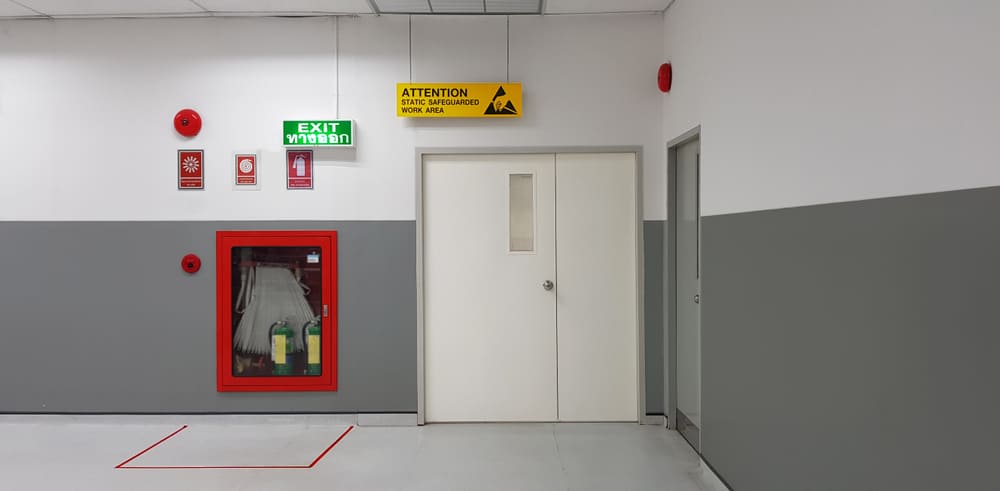
▶ Types of panic exit locks
The fundamental function of an anti-panic lock is always the same. In an emergency, occupants must be able to leave the building quickly without using a key or another access credential. However, there are different lock and door-furniture configurations.
❯ Lever furniture vs fixed external furniture
In short: a lever/lever door has a working handle on both sides, while fixed external furniture leaves no operable handle outside, so authorised access must come from the locking system itself.
One difference lies in the door furniture fitted to the door.
A conventional lever/lever arrangement has a lever handle on both sides of the door. Depending on the lock function, the external lever can be enabled or disengaged while the internal lever remains available for escape.
Alternatively, the door can be fitted with an internal lever handle and fixed external furniture, such as a fixed knob or pull handle. In this arrangement, there is no operable lever handle on the outside, so authorised access from the secure side must be provided by the locking system.
❯Self-locking vs multipoint locking
In short: self-locking means the door secures itself automatically on closing, while multipoint locking means the door is held at several points rather than one, and a doorset can combine both.
Although self-locking and multipoint locking describe different characteristics, they are not mutually exclusive.
A self-locking lock automatically secures the door when it closes. The door does not simply reopen from the secure side, while operation of the appropriate exit hardware from the escape side still allows occupants to leave.
Multipoint locking means that the door is secured at several locking points rather than at a single point, and self-locking and multipoint locking can therefore be combined where the doorset and hardware configuration are designed and approved for this purpose.
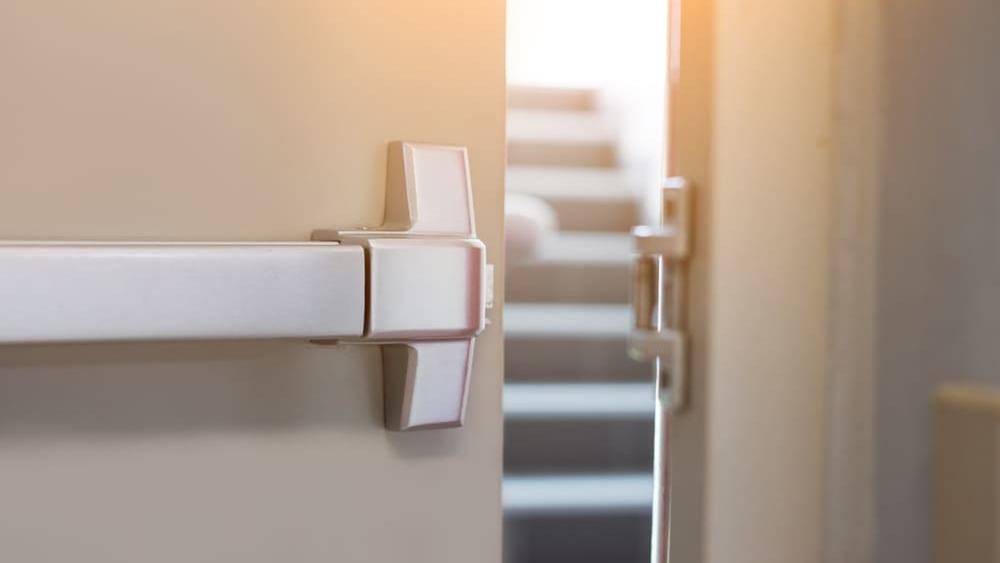
▶ Functions of a panic exit lock
Different panic-lock functions are available according to the door furniture and the required access behaviour. Functions B, C and D are associated with configurations using lever handles, while Function E is used with fixed external furniture.
Panic lock Function B: switchable function
In short: the external lever can be switched between disengaged and enabled, so outside access can be turned on or off as needed.
With Function B, the external lever handle can be disengaged. In this state, operating the external lever does not open the door, so access from outside is not possible without the appropriate key or authorised credential.
The lock can be switched between the disengaged state and an enabled state. Once enabled, the external lever can operate the door, allowing free access from outside until the function is switched back.
Panic lock Function C: key-controlled function
In short: the external lever always stays disengaged, and outside access is only ever possible using the correct key.
With Function C, the external lever remains disengaged and cannot be switched into a permanently enabled state.
Access from outside is only possible when the appropriate key is used. The key engages the external operating function to allow the door to be opened, and the door must then be secured again before the key can be removed.
Panic lock Function D: passage / emergency access function
In short: the external lever stays enabled after an authorised unlock, useful for letting emergency services or authorised staff back through the door.
With Function D, the external lever can remain engaged following an authorised unlocking operation, allowing the door to be opened from outside.
This is useful where access from the secure side needs to remain available after the door has been unlocked, for example to provide access for authorised personnel or emergency services. The external access function remains active until the door is deliberately secured again.
Panic lock Function E: fixed external furniture function
In short: the outside of the door has fixed, non-operable furniture, so entry from outside always requires a key or authorised credential.
With Function E, the outside of the door has fixed furniture, such as a fixed knob or pull handle, rather than an operable lever.
The door therefore cannot be opened freely from outside, and access requires the appropriate key or another authorised credential. From the escape side, the specified exit hardware allows the door to be opened without a key or credential.
▶ When are panic exit devices required?
In short: BS EN 179 applies where users are familiar with the escape route and panic is unlikely, while BS EN 1125 applies where the public or unfamiliar users may be present and panic could occur.
The type of exit hardware required depends on the building, its occupancy, the expected behaviour of users and the building's fire strategy.
Where occupants are likely to be familiar with the building and its escape routes and a panic situation is unlikely, an emergency exit device operated by a lever handle or push pad may be appropriate. These devices fall within the scope of BS EN 179.
Where members of the public or other users may be unfamiliar with the escape routes and a panic situation could occur, a panic exit device complying with BS EN 1125 may be required. These devices use a horizontal push bar or touch bar extending across the door, allowing the door to be operated intuitively even where people are pressing against it.
For Facility Management teams, the appropriate solution should therefore be determined according to the building's use, occupancy, fire risk assessment and escape strategy rather than solely by the type of premises. This is also directly relevant to duties under the Terrorism (Protection of Premises) Act 2025, commonly known as Martyn's Law. See our guide to smarter access control for safer high-footfall venues for how this fits into a wider compliance strategy.
▶ Retrofitting panic exit hardware
Panic exit hardware can also be retrofitted to existing buildings. This may be necessary following alterations to the building, a change in occupancy or modifications to the escape strategy that create new requirements for escape doors.
Because panic exit locks are commonly based on mortice-lock configurations, replacement or retrofitting may be relatively straightforward in suitable doors.
However, the complete doorset needs to be considered when making alterations. This includes the lock or exit device, door leaf, frame, hinges, keeps, door closer and any associated access-control equipment. Where the door is also a fire-resisting or smoke-control door, the replacement hardware must be compatible with the required performance of the doorset.
▶ Panic exit locks in a digital locking system
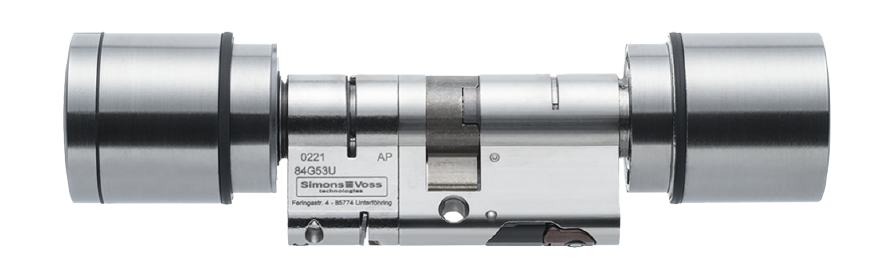
In short: SimonsVoss's Anti-panic double thumb-turn cylinder adds electronic access control to an escape door without compromising the panic function required for safe egress.
Anti-panic functionality is not limited to mechanical locking systems. Digital locking systems can also incorporate anti-panic cylinders designed specifically for suitable escape-door applications.
SimonsVoss offers the Anti-panic double thumb-turn cylinder, which has been developed for use in anti-panic locks on escape and rescue routes. Authorised users can operate the cylinder using an appropriate electronic credential, while the panic function of the lock ensures that the door can still be opened from the escape side without a credential in an emergency. This allows organisations to combine safe egress with the operational benefits of digital access management, of the kind used across the wider SimonsVoss System 3060 access control range.
If an electronic credential is lost, for example, it can simply be blocked within the digital locking system. The lost credential can then no longer be used to gain authorised access through the affected door from the controlled side, and there is no need to replace mechanical keys and locking cylinders simply because an electronic credential has been lost.
Anti-panic cylinders must always be used with locks specifically approved for the relevant cylinder. The panic function of the complete lock and doorset must remain fully operational, and a function test should be carried out after installation or relevant maintenance work.
FAQ
What is the difference between BS EN 179 and BS EN 1125?
BS EN 179 covers emergency exit devices operated by a lever handle or push pad, for use where people are familiar with the exit and a panic situation is unlikely. BS EN 1125 covers panic exit devices operated by a horizontal bar, for use where the public or other unfamiliar users may be present and a panic situation could occur.
Can a panic exit lock be retrofitted to an existing door?
Yes, panic exit hardware can be retrofitted, and because these locks are commonly based on mortice-lock configurations, this can be relatively straightforward on suitable doors. The complete doorset, including the frame, hinges, keeps and closer, needs to be considered, and any fire-resisting or smoke-control performance requirements must still be met.
Are panic exit locks compatible with digital access control systems?
Yes. SimonsVoss offers an Anti-panic double thumb-turn cylinder designed for use in anti-panic locks on escape and rescue routes. It allows authorised users to operate the door using an electronic credential, while ensuring the door can still be opened from the escape side without a credential in an emergency.
What happens if an electronic credential for an anti-panic cylinder is lost?
The credential can simply be blocked within the digital locking system, so it can no longer be used to gain authorised access from the controlled side. There is no need to replace mechanical keys or locking cylinders as a result.
Do you have further questions about panic exit locks?
We will be happy to help. If you are considering anti-panic locks as part of an electronic locking system, get in touch and we will help you find a solution tailored to your individual security and access requirements.