

Retrofitting
Retrofitting means upgrading an existing building's locks with modern digital access control, without needing to replace doors or carry out major structural work. It typically starts by swapping mechanical cylinders for digital ones, then extends to centrally managed access permissions and, where needed, connecting security-critical doors to a wider online or cybersecurity infrastructure. This glossary entry explains why retrofitting starts at the door, how offline, online and hybrid systems compare, and what the retrofit process looks like in practice.
Inhalt:
▶ Definition: Retrofitting
In short: retrofitting means modernising an existing building's locks and access control with digital technology, rather than replacing doors or carrying out major building work.
Retrofitting, or simply a retrofit, means modernising and upgrading an existing building or system with new technology. Digital retrofitting in existing buildings involves integrating modern sensors, communications technology, automation and software components.
In addition to improving security, retrofitting electronic door locks makes it possible to manage, record and analyse locking and access processes.
Retrofitting can therefore address outdated security arrangements while also responding to growing operational requirements, rising maintenance costs and the need for greater scalability.
▶ Objectives of retrofitting existing buildings
In short: retrofitting replaces fragmented, ageing key arrangements with a structured system covering security, compliance, convenience and scalability.
Retrofitting tackles security risks where they arise: at the door.
In older and existing buildings, doors and locks are often added or replaced over many years. Different types of door furniture accumulate, keys are lost and keying plans become outdated or are forgotten altogether. The result is an organisational security risk: it may no longer be clear who actually has access to which areas.
Retrofitting replaces fragmented solutions with a more structured approach. The benefits include:
❯ Energy and operations: increase efficiency, reduce operating costs and extend service life.
❯ Security: control access, prevent misuse and support emergency procedures.
❯ Convenience: introduce role-based and time-based permissions, self-service workflows and visitor management.
❯ Visibility: centrally monitor system status, access events and maintenance requirements.
❯ Compliance: support documentation, audit and evidence requirements.
❯ Scalability: scale the solution from an individual building to an entire corporate campus.

▶ Why start at the door?
In short: digital locks let you assign, time-limit and revoke access from software, cutting the response time to a lost credential from days to minutes.
Digital security is only as effective as the controls governing physical access.
With digital locking systems, access permissions are assigned through software and can be revoked immediately when necessary. Permissions can be time-limited and individually configured for each door. Changes can take effect within minutes, while access events remain traceable.
If a credential is lost, the response time can therefore be reduced from days to minutes.
Sensitive areas, such as the building perimeter, IT and plant rooms, and archives, can be subject to stricter controls, while office areas or production environments may require a lower security level.
A hybrid approach is often effective: security-critical doors are monitored online, providing live status information and rapid credential blocking, while less critical doors operate offline. This minimises infrastructure requirements while providing real-time capabilities where they matter most.
▶ System options: offline, online and hybrid
The system architecture determines both how quickly Facility Management and security teams can respond and how much infrastructure is required. In many environments, a hybrid solution offers an effective balance.
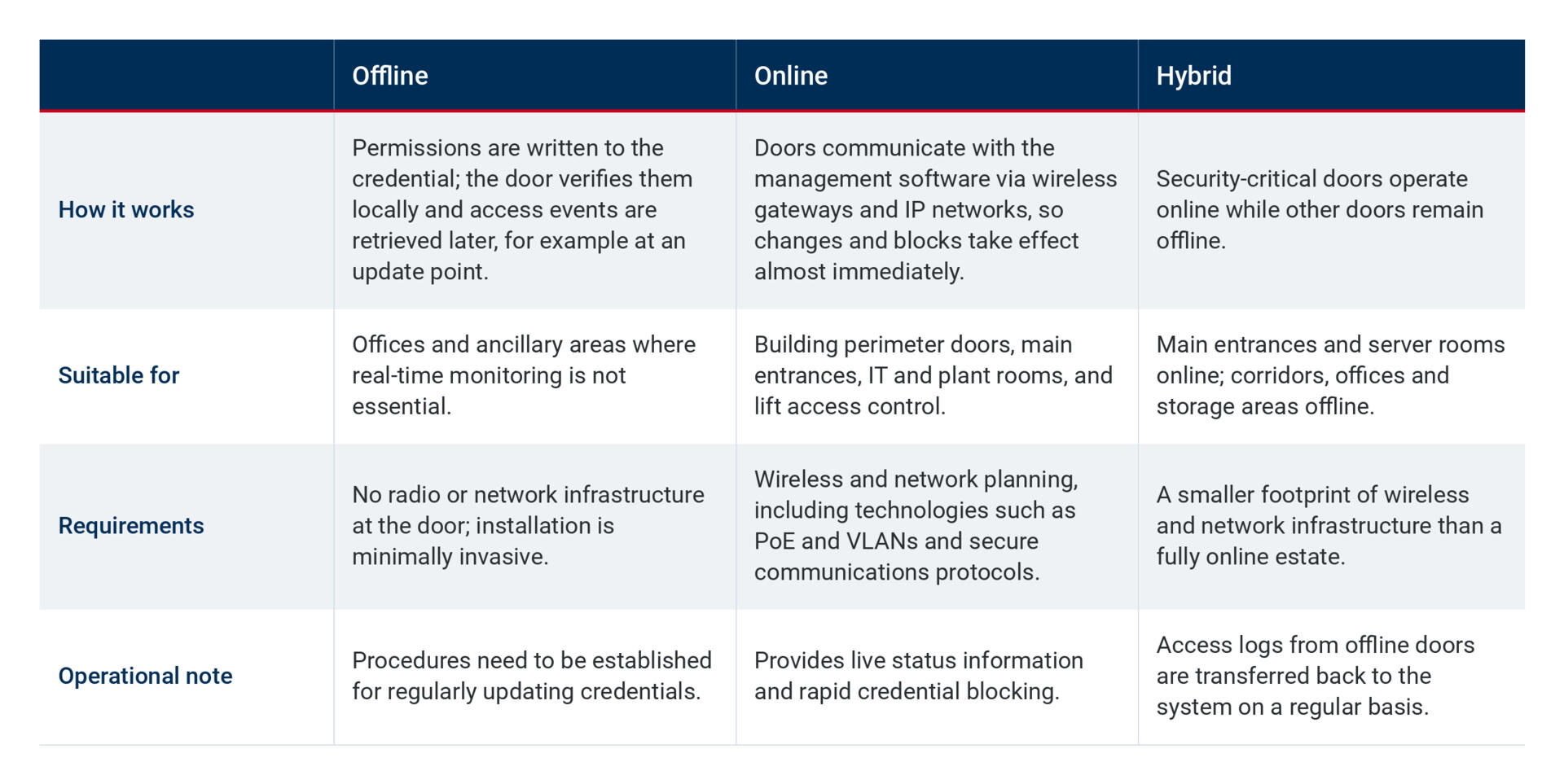
A typical hybrid example is main entrances and server rooms operating online, while corridors, offices and storage areas operate offline, with access logs transferred back to the system on a regular basis. Read more about how wireless access control integrates with building management systems for the infrastructure side of an online or hybrid rollout.
▶ Retrofitting digital locking solutions: the process
In short: retrofitting replaces mechanical cylinders or door furniture door by door, so an existing building can be modernised without extensive or invasive building work.
Retrofitting digital locking solutions allows existing buildings to be modernised without extensive or invasive building work. Mechanical cylinders or door furniture are replaced, access permissions are managed centrally, and security-critical doors can optionally be connected online.
Careful advance planning helps improve security while keeping alterations to the existing building fabric to a minimum.
Retrofitting step by step
1. Assess the existing estate and define objectives. Compile a door schedule and establish relevant requirements for escape routes, fire safety and, where applicable, heritage protection. Define user roles, time profiles and access zones.
2. Select the technology. Choose suitable digital cylinders and electronic door furniture and, where required, wall readers or relays. Use offline components for standard doors, online connectivity for security-critical areas, or combine both in a hybrid solution.
3. Run a pilot. Equip five to ten representative doors and test access-permission management and procedures for lost credentials. Use the findings to refine operational processes.
4. Plan the rollout. Implement the solution in logical clusters, using preconfigured profiles, defined installation windows and clear responsibilities.
5. Installation and commissioning. Replace the relevant hardware, activate online connectivity where required, test functionality and escape-route operation, and document commissioning and acceptance.
6. Operation and optimisation. Train administrators and users, manage changes centrally, review logs and battery levels, and adjust access zones where necessary.
How is the existing estate assessed?
The assessment begins by recording the use of each door, the existing door furniture, door-leaf thickness and any applicable requirements, including those relating to escape routes.
This information can then be used to establish priorities. Building perimeter doors and IT or plant rooms may be addressed first, with offices and ancillary areas incorporated during the subsequent rollout.
Where existing fire doors or escape doors are involved, the compatibility of new locking hardware with the required performance of the complete doorset must be considered.
Where the property is a listed building, proposed alterations should also be assessed for any relevant heritage-consent requirements before work begins.
Which components are used?
- A typical retrofit draws on a mix of the following component types:
● Digital cylinders, such as the SimonsVoss Digital Cylinder AX: a direct replacement for mechanical locking cylinders, completely wireless, with variants suitable for external doors.
● Electronic door furniture, such as the SimonsVoss SmartHandle AX: intelligent electronic door furniture for suitable applications.
● Electronic door furniture with extended functionality, such as the SimonsVoss SmartHandle AX Advanced: additional functions for centrally managed doors in high-traffic or security-critical areas.
● Relay modules, such as the SimonsVoss SmartRelay: enable lifts, barriers, automatic doors or locker locks to be incorporated into the access-control logic.
● Electronic locker locks, such as the SimonsVoss SmartLocker AX : suitable for changing rooms, lockers and personal storage, with integration into the wider access-control system.
● Credentials, including cards, transponders and mobile IDs on smartphones.
● Management software, such as AX Manager: manages roles, time profiles, door groups and access-event logging.
How is a retrofit implemented in an existing building?
Installation can be carried out door by door while the building remains operational.
For smaller pilot projects, an initial group of 10 to 20 doors can be converted first. This allows roles, time profiles and lost-credential procedures to be tested under real operating conditions.
The system can then be rolled out in logical clusters, for example floor by floor.
Does a retrofit change day-to-day operations?
Monitoring provides visibility of battery levels and the status of connected doors.
Battery replacement, software or firmware updates and other maintenance activities can therefore be scheduled within planned maintenance windows. Event logs provide an auditable record of relevant system activity.
▶ Retrofitting risks and solutions
Different door types and non-standard dimensions
Older buildings often contain a mixture of door furniture, backsets and escape-route requirements.
Solution: carry out a comprehensive door survey before work begins. Select components offering suitable variants, including non-standard lengths and indoor/outdoor versions, and migrate security-critical doors first.
Heritage requirements and minimal intervention
Visible alterations may be restricted in historic and listed buildings.
Solution: use battery-powered cylinders and electronic door furniture that require no cabling, choose discreet hardware and work with existing door geometries wherever possible. Online functionality can be provided via strategically positioned gateways rather than by cabling individual doors.
Where alterations to a listed building could affect its special architectural or historic character, the relevant heritage-consent requirements must be established before work begins.
Wireless and network planning for online doors
Thick walls, service shafts and metal structures can attenuate wireless signals.
Solution: use a small number of strategically positioned gateways, conduct an on-site wireless survey and use a dedicated VLAN with appropriately restrictive rules. Provide suitable resilience for security-critical doors or operate them offline where appropriate.
Unclear responsibility for assigning access permissions
Security can be undermined by inadequate processes even when the technology itself is robust.
Solution: establish a role model with clearly defined approval responsibilities, fixed expiry periods for temporary permissions, dual authorisation for large-scale changes and documented procedures for lost credentials.
Operational disruption during installation
Occupied buildings leave little room for prolonged disruption.
Solution: replace components door by door within short installation windows. Use a pilot area of 10 to 20 doors to refine the process before rolling out the solution in clusters, and keep replacement credentials and mobile IDs available where appropriate.
Lifecycle and upgradeability
Outdated firmware or unavailable replacement components can cause operational problems.
Solution: establish planned update windows, use signed firmware with rollback capability where supported, and maintain a documented inventory for each door, including its ID, installed components and battery type. The long-term availability of critical components should also be considered.
▶ From planning to implementation
Retrofitting can bring modern digital security to existing buildings while limiting physical alterations to what is genuinely necessary.
The trend is towards hybrid operation, mobile credentials and standardised interfaces with building management and HR/identity-management systems. As a result, access permissions increasingly follow operational processes, such as onboarding and offboarding, contractor management and events, rather than being driven by physical key circulation and the maintenance of mechanical keying plans.
In the future, building operations are likely to become even more data-driven. Battery levels, door usage and failed access attempts can feed into maintenance and security decisions.
At the same time, expectations around auditability and data protection continue to increase. Organisations that establish robust role models, encrypted communications and secure update processes at an early stage can reduce both operational effort and security risk. Our guide to digital key management covers the credential and permissions side of this in more detail.
FAQ
What is the difference between an offline, online and hybrid retrofit?
An offline door verifies permissions locally, with no network connection at the door itself, so it needs no wireless infrastructure but relies on procedures to keep credentials updated. An online door connects to the management software through a wireless gateway, so changes and credential blocks take effect almost immediately. A hybrid system puts security-critical doors online while keeping the rest offline, balancing infrastructure cost against response time.
How many doors should a retrofit pilot cover?
A pilot of five to ten representative doors is generally enough to test access-permission management and lost-credential procedures before a wider rollout, though some pilot projects extend to 10 to 20 doors where the estate is larger or more varied.
Can a listed or heritage building be retrofitted with digital locks?
Yes, in many cases. Battery-powered cylinders and electronic door furniture require no cabling, which helps keep visible alterations to a minimum. Where a building is listed, any proposed alterations should still be assessed for heritage-consent requirements before work begins.
How quickly can a lost credential be blocked after a retrofit?
Because permissions are managed through software rather than physical keys, a lost credential's access can typically be revoked within minutes, compared with the days it can take to identify and rekey affected mechanical cylinders.